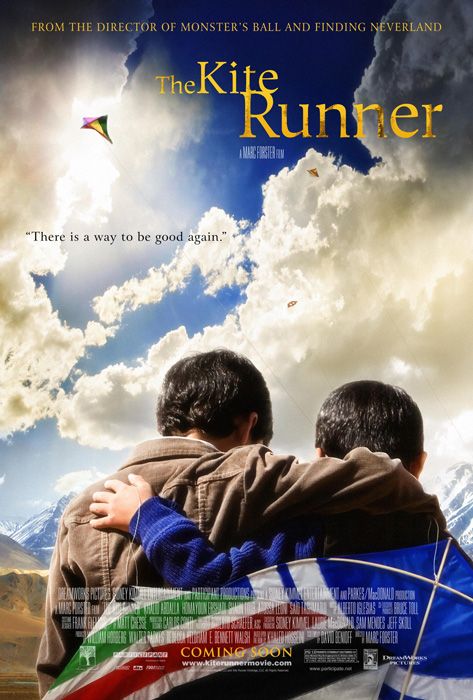
In the beginning of the book we see the complex relationship between Hassan and Amir. “The curious thing was, I never thought of Hassan and me as friends either. Not in the usual sense, anyhow. Never mind that we taught each other how to ride a bicycle with no hands, or to build a home made camera out of a cardboard box. Never mind that that we spent entire winters flying kites, running kites. Never mind that to me, the face of Afghanistan is that of a boy with a thin boned frame, shaved head, and lowest ears, a boy with a Chinese doll face perpetually lit by a hare lipped smile.
Never mind any of those things. Because history isn’t easy to overcome. Neither is religion. In the end I was a pashtun and he was a Hazara, I was Sunni and he was Shi’a, and nothing was ever going to change that. Nothing.”(25). This passage exhibits the complexity of Amir and Hassan’s relationship. Amir is saying that even though they are friends they cannot be. This is illustrated by the structure of the paragraph. After a certain point every single sentence begins with “Never mind that,” this structure implies that they are friends it is just socially unacceptable for them to be because of their different ethnic groups and religions. At the same time the paragraph would seem like a description of what Amir does with his best friend. It is also important that Amir identifies his country as Hassan the person he cannot say he is friends with.
This difference between Amir and Hassan is a large issue in the book. And takes place as many internal struggles for Amir. Amir partly wants to be equal with Hassan but at the same time he cannot help but revert to their ethnic differences.
“’What does that word mean?’ [Hassan asked]
‘which one?’ [replied Amir]
‘imbecile,’
‘you don’t know what that means?’ I said grinning.
‘nah Amir agha.’
‘But it is such a common word!’
‘still I do not know it.’ If he felt the sting of my tease, his smiling face did not show it.
‘Well everyone in school knows what it means,’ I said ‘lets see, ‘ ’Imbecile.’ It means smart, intelligent. I’ll use it in a sentence for you. ‘When it comes to words Hassan is an imbecile.”(29). This scene clearly illustrates how Amir sometimes acts superior. The diction of this passage also illustrates their relative positions, because the title “Agha” would only be a title for an adult not a friend. The content of the passage has a clear intent as well. The author’s intent was to show how Amir is quick to play a prank that he would have never play on an equal. This kind of treatment of the Hazara people is common in the book and illustrates the inequalities of the people. For example a similar event is when Amir describes how he tries to imitate Ali’s, Hassan’s father who has a crippled leg, walk. This is also treatment that would be unacceptable to any other adult. However despite this poor treatment of Hassan, Amir says that he feels guilty. This is because of Hassan’s trusting nature and Amir’s deceptive one.
Another theme that is explored is courage. Constantly in the book Amir tries to be brave and always regrets that others are brave and that he is not. “’Last chance, Hazara.’ Hassan’s answer was to cock the arm that held the rock. ‘Whatever you wish.’ Assef unbuttoned his winter coat, took it off, folded it slowly and deliberately. He placed it against the wall. I opened my mouth, almost said something. Almost. The rest of my life might have turned out differently if I had. But I didn’t. I just watched. Paralyzed… I had one chance to make a decision. One final opportunity to decide who I was going to be. I could stand up for Hassan – the way he’d stood up for me all those times in the past – and accept whatever would happen to me. Or I could run. In the end I ran. I ran because I was a coward. I was afraid of Assef and what he would do to me. I was afraid of getting hurt”(73-77). This passage takes place after Amir has won the kite-flying contest. Hassan goes to run the kite, but when he doesn’t return Amir goes to look for him. Finally Amir discovers that a gang of bullies who are out for revenge have corned Hassan. Amir is to scared to intervene and consequently Hassan gets raped. This cowardice has very adverse effects on Amir that was foreshadowed by the author “I opened my mouth, almost said something. Almost. The rest of my life might have turned out differently if I had”(73). This critical decision rocks Amir to his core. Mostly it is out of shame of his actions. This passage also illustrates how Amir can’t allow him self to openly be friends with Hassan and protect him, the way that Hassan protected Amir. Amir sufferers for his decision to not intervene in many ways, at the sound of Hassan’s name he cannot breath and often vomits from thinking about him. He also becomes an insomniac. The need to be brave and repent for his mistake haunts him when his cowardice fails him later. His father Baba prevents the rape of a lady passenger and is willing to die for decency. His wife is brave enough to tell him he deepest secret while he remains silent. Finally the chance for redemption presents its self when Amir returns to Afghanistan to find his nephew and take him to safety. In order to succeed he is challenged to a death match by Assef. “ I don’t know at what point I started laughing, but I did. It hurt to laugh, hurt my jaw, my ribs, my throat. But I was laughing and laughing. And the harder I laughed, the harder he kicked me, punched me, scratched me
‘WHATS SO FUNNY?’ Assef kept roaring with each blow spittle landed in my eye. Sohrab screamed.
‘WHATS SO FUNNY?’ Assef bellowed. Another rib snapped this time left lower. What was so funny was that, for the first time since the winter of 1975, I felt peace. I laughed because I saw that, in the hidden nook in the corner of my mind, I’d even been looking forward to this… I felt healed. Healed at last. I laughed”(289). Clearly in this passage Amir corrects his past errors. Being beaten to the edge of his life is the punishment he has desired because he should have taken it long before. He feels like this sacrifice for Sohrab is finally enough to remove his guilt.
Another theme in the book is Amir’s relationship with Baba his father. “In my head I had it all planned I’d make a grand entrance, a hero, prized trophy in bloodied hands… then the old warrior would walk to the young one, embrace him, acknowledge his worthiness. Vindication. Salvation. Redemption. And then? Well happily ever after, of course. What else?”(67). This passage is interesting because the structure illustrates Amir’s desires. He wants his father to think that he is worthy. The interesting thing is that he is unsure of what the result of his fathers love will be. All he knows is that his desires are pointed straight at his father.

Nice start Ezra. Fine analysis and well selected quotes. The one thing I am picking up on is your understanding of theme which seems to be a bit simplified. For instance, "courage" is not a theme... what is KH saying ABOUT courage... I think you note it later on when you note, "cowardice has very adverse effects." Same with the note about the father-son relationship... what about such relationships is revealed through theme?
ReplyDelete25/25